
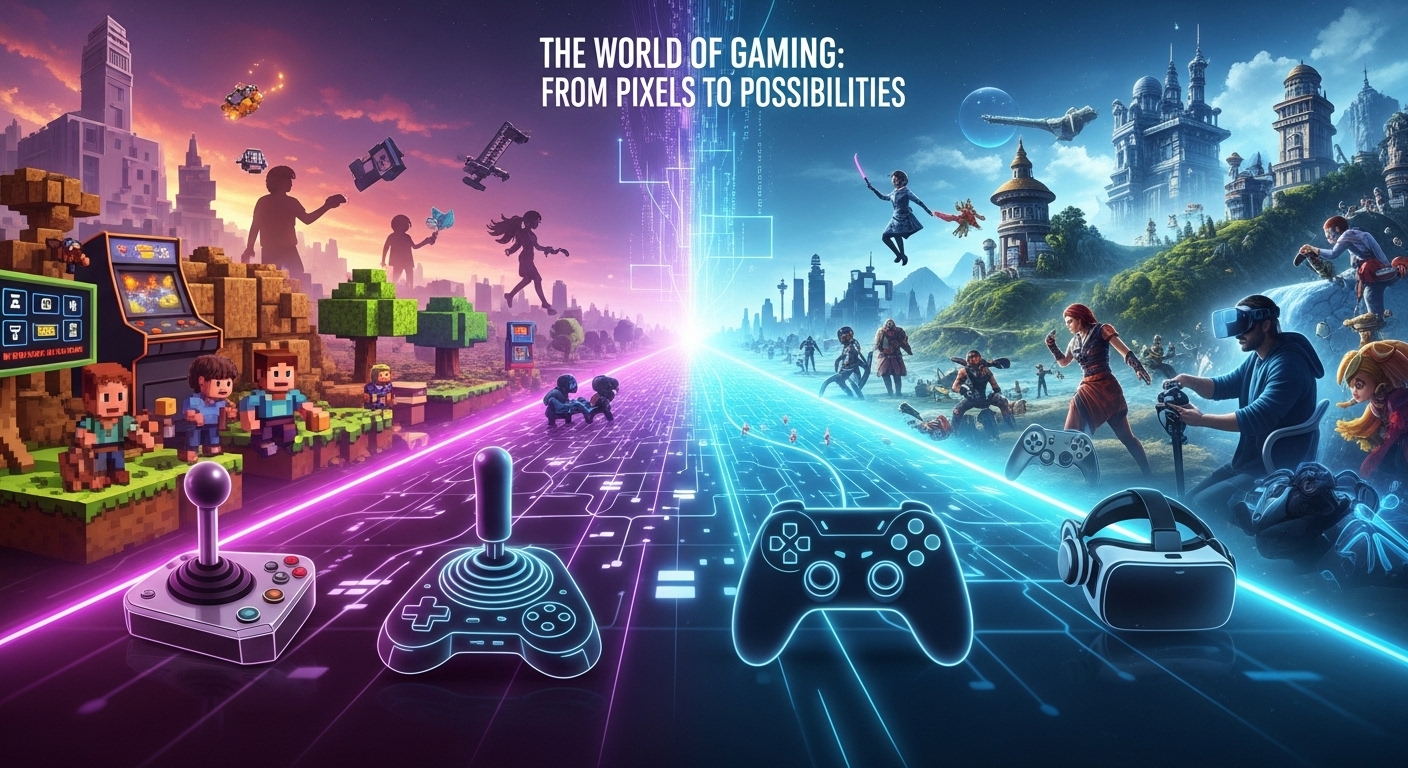
Gaming has grown from a niche hobby enjoyed by a few enthusiasts into a global cultural phenomenon that defines entertainment in the modern age. What began as a handful of pixels moving across a black screen has become a billion-dollar industry filled with breathtaking worlds, emotional storytelling, and communities that span the globe. The evolution of gaming tells not just a technological story but also a deeply human one—about imagination, creativity, and our relentless desire to play.
The Birth of Digital Play
The story of gaming begins in the laboratories and universities of the 1950s and 60s. Back then, computers were enormous machines that filled entire rooms and were designed for research, not recreation. Yet, curiosity has always been at the heart of innovation. Early programmers began to experiment with these machines, creating simple games to test their capabilities. One of the earliest examples was “Spacewar!” created in 1962 by Steve Russell and his team at MIT. It was a simple two-player game in which spaceships battled each other around a star, but it marked a turning point. For the first time, humans interacted with computers purely for fun.
From there, the idea of electronic gaming began to spread. In 1972, “Pong” became the first commercial arcade success, transforming gaming from a technical curiosity into an industry. Its simple concept—two paddles and a ball bouncing between them—proved that interactivity could captivate people in a way no other form of entertainment could. Arcades began popping up across cities, filled with flashing lights, cheerful noise, and lines of eager players.
The Golden Age of Arcade Games
The late 1970s and early 1980s are often considered the golden age of arcade gaming. Titles like “Space Invaders,” “Pac-Man,” “Donkey Kong,” and “Galaga” turned gaming into a cultural movement. Arcades became social hubs where friends competed for high scores, strangers challenged each other, and players learned new strategies through sheer repetition and practice.
Each game was a unique test of reflexes, pattern recognition, and endurance. The appeal lay in their simplicity—easy to learn, hard to master. These games didn’t have elaborate stories or cinematic visuals, but they possessed something even more powerful: the thrill of competition and the joy of mastery. Gamers of that era remember the flashing neon lights, the sound of coins dropping into machines, and the collective excitement that came with every new title.
The Rise of Home Consoles
While arcades dominated public spaces, a revolution was happening at home. In the mid-1970s, consoles like the Magnavox Odyssey and the Atari 2600 brought gaming into living rooms. Suddenly, the experience of play was no longer limited to arcades—it became a family activity. Games like “Adventure” and “Pitfall!” introduced players to open-ended exploration, paving the way for the adventure and role-playing genres that would define later decades.
By the 1980s, competition in the console market grew fierce. Nintendo entered the scene with the Nintendo Entertainment System (NES), a console that would change the gaming world forever. With its tight controls, colorful graphics, and unforgettable titles like “Super Mario Bros.,” “The Legend of Zelda,” and “Metroid,” Nintendo set a new standard for quality and creativity. The NES was not just a device—it was a gateway to imagination. Children no longer needed to visit arcades to experience magic; it lived right in their homes.
The Console Wars and 16-Bit Glory
The 1990s saw gaming mature in ways few expected. The era was defined by the so-called “console wars” between Nintendo and Sega. Sega’s Genesis and Nintendo’s Super Nintendo Entertainment System (SNES) battled fiercely for dominance. Each offered iconic franchises—Sonic the Hedgehog on one side, Super Mario and Zelda on the other.
This competition drove rapid innovation. Graphics improved dramatically, soundtracks became richer, and stories grew deeper. Games like “Chrono Trigger,” “Final Fantasy VI,” and “Super Metroid” told sweeping tales that rivaled books and movies. Platformers, fighting games, and RPGs thrived. The 16-bit era also gave rise to esports’ earliest seeds through competitive games like “Street Fighter II” and “Mortal Kombat.”
Meanwhile, PC gaming was carving its own path. The rise of personal computers led to classics such as “Doom,” “SimCity,” and “Civilization.” These titles pushed technological boundaries and introduced new genres. First-person shooters, strategy games, and simulation titles flourished on PC, offering depth and complexity that consoles couldn’t match at the time.
The Leap to 3D Worlds
The mid to late 1990s brought perhaps the most dramatic shift in gaming history—the move from 2D to 3D. This change wasn’t just visual; it redefined how games were designed and played. Titles like “Super Mario 64,” “Tomb Raider,” and “The Legend of Zelda: Ocarina of Time” demonstrated the potential of fully realized 3D environments. Players could now explore worlds that felt alive, with depth and dimension previously unimaginable.
The transition to 3D also paved the way for new storytelling techniques. Camera angles, voice acting, and cinematic cutscenes turned games into interactive movies. Developers began to think of players not just as participants but as protagonists within living stories. The PlayStation, released by Sony in 1994, became a massive success by embracing this new direction. Games such as “Final Fantasy VII,” “Metal Gear Solid,” and “Resident Evil” showed how narrative and emotion could elevate gaming into an art form.
Online Gaming and the Birth of Digital Communities
As the new millennium approached, the internet changed everything. Online gaming transformed isolated experiences into connected worlds. Early PC titles like “Ultima Online” and “EverQuest” introduced players to massively multiplayer online role-playing games (MMORPGs). These games allowed thousands of players to interact in shared universes, forging friendships, rivalries, and memories.
By the early 2000s, broadband internet enabled console gamers to join the fun. Microsoft’s Xbox Live service revolutionized multiplayer gaming, bringing smooth online play, voice chat, and global leaderboards to consoles. Games like “Halo 2” and “Call of Duty” became social phenomena, turning online matches into nightly rituals for millions. The idea of gaming as a solitary pastime was gone forever—now, it was a social network before social media even existed.
The Era of High Definition
The late 2000s ushered in the era of high-definition gaming with consoles like the Xbox 360, PlayStation 3, and Nintendo Wii. Graphics reached cinematic levels of realism. Developers used powerful engines to craft breathtaking worlds filled with detail, light, and motion. Games like “Uncharted,” “The Elder Scrolls V: Skyrim,” and “Red Dead Redemption” blurred the line between movie and game, offering vast open worlds where players could write their own stories.
At the same time, indie developers began to rise, thanks to digital distribution platforms. Titles like “Braid,” “Limbo,” and “Minecraft” proved that innovation wasn’t limited to big studios with massive budgets. Indie games brought creativity, experimentation, and emotional storytelling to the forefront. They reminded players that gaming was as much about artistry as it was about technology.
The Mobile Revolution
When smartphones entered the scene, gaming reached a level of accessibility never seen before. Suddenly, anyone with a phone could be a gamer. Titles like “Angry Birds,” “Candy Crush,” and “Clash of Clans” captivated millions. Mobile gaming broke demographic boundaries, attracting players of all ages and backgrounds.
This new frontier changed how games were developed and monetized. Free-to-play models and microtransactions became common, reshaping the economics of gaming. While some criticized these trends, mobile gaming also introduced millions of new players to interactive entertainment. It became a gateway for casual gamers who might never have picked up a console controller.
The Rise of Esports and Streaming
In the 2010s, competitive gaming evolved into a legitimate sport. Esports tournaments filled stadiums, with players competing for multimillion-dollar prizes. Titles like “League of Legends,” “Dota 2,” and “Counter-Strike: Global Offensive” built massive professional scenes. Fans followed their favorite teams, commentators became celebrities, and streaming platforms turned gamers into influencers.
Twitch and YouTube Gaming transformed how people consumed games. Watching others play became as entertaining as playing itself. Streamers and content creators developed unique communities, each with its own humor, culture, and style. Gaming became a spectator event, accessible 24/7 from any device.
Immersive Realities: VR, AR, and Beyond
As technology advanced further, gaming entered the realm of immersion. Virtual reality (VR) and augmented reality (AR) took interactivity to the next level. With devices like the Oculus Rift, PlayStation VR, and later the Meta Quest series, players could physically step into digital worlds. Games like “Beat Saber,” “Half-Life: Alyx,” and “Superhot VR” showcased what it meant to truly feel inside a game.
AR, on the other hand, blended the real world with the digital. “Pokémon GO” became a cultural phenomenon, encouraging millions to explore their surroundings through gameplay. It was more than a game—it was a social and physical experience that merged reality with fantasy.
The Art of Storytelling in Modern Games
Modern games are more than just challenges or pastimes—they are powerful storytelling tools. Developers now treat narrative as a core component, not an afterthought. Games like “The Last of Us,” “God of War,” “Ghost of Tsushima,” and “Cyberpunk 2077” explore deep themes of love, loss, and identity. They rival the emotional depth of films and novels while offering a unique sense of agency that only interactivity can provide.
Players don’t just watch stories—they live them. Every choice matters, every consequence feels real. This emotional connection has turned gaming into one of the most expressive art forms of the 21st century. The line between player and character blurs, creating experiences that linger long after the screen goes dark.
The Power of Community
One of gaming’s greatest strengths lies in its communities. From online guilds to fan conventions, gaming has built friendships and even families. Whether through cooperative play or shared fandoms, games unite people across continents and cultures. Communities form around creativity, modding, speedrunning, and content creation. The shared love of gaming fosters connection and collaboration, reminding us that play is universal.
Even in times of isolation, gaming offers companionship. During global events that kept people apart, online gaming became a way to stay connected, laugh, and share moments. Virtual worlds provided comfort, and communities became support systems. The bonds formed through play often extend far beyond the screen.
The Future of Gaming
Looking forward, the future of gaming promises even greater transformation. Cloud gaming aims to make high-end experiences accessible without expensive hardware. Artificial intelligence will create more responsive and lifelike virtual worlds, adapting to player behavior in real time. Virtual and augmented reality will continue to evolve, breaking down the barriers between the digital and physical.
Gaming will also become more inclusive. Developers are increasingly focused on accessibility, representation, and diversity. Games are being designed for people with disabilities, offering customizable controls, subtitles, and adaptive technologies. Storylines are embracing broader perspectives, reflecting the rich diversity of the global gaming community.
Perhaps most exciting of all is the potential for creativity. With tools becoming more user-friendly, more players are becoming creators themselves. Platforms that allow players to build, share, and modify games ensure that the next generation of innovators could come from anywhere.
Conclusion: From Pixels to People
The journey of gaming is a reflection of human progress—technological, artistic, and emotional. It began with curiosity, grew through competition, and now thrives on connection. What started as a few blinking lights has become an entire universe of imagination and interaction.
Gaming has never been just about the technology. It’s about people—the developers who dream, the players who explore, and the communities that come together. Every era, every generation of games, brings new stories, new worlds, and new memories. From the first pixel to the most photorealistic world, the essence of gaming remains the same: joy, challenge, and discovery.
As we look to the future, one thing is certain—the game never truly ends. It evolves, expands, and continues to bring people together in ways no other medium can. Gaming is not just entertainment. It is art, culture, and a shared human experience that will keep shaping our world for decades to come.